 ....... .......
By Ron Cook
That's the call a fire department received last winter from a base-housing
inspector. The inspector had been doing normal bi-monthly checks of vacant
units when this happened. The inspector's usual procedure was to run the
cold water in the kitchen sink, turn on the dishwasher, go upstairs to
flush the commode, and run the water in the bathroom. About three minutes
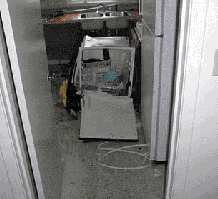
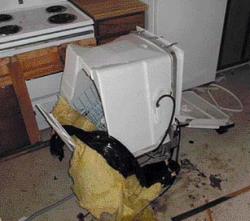
after she started the dishwasher, it exploded. The blast propelled the
dishwasher (which was installed under the kitchen counter) across the kitchen.
The cabinets, plumbing and walls were damaged. The concussion splintered
the face of the rear door to the housing unit and blew it open, destroying
the lock. Pieces of the dishwasher and cabinets were scattered over 20
feet. The access panel to the attic on the second floor was dislodged,
and the front door was blown open and damaged. At first, investigators
thought water in the "s" trap had evaporated, allowing sewer gas to seep
into the dishwasher and explode. The next day, Navy Occupational Safety
and Health (NAVOSH) technicians tested all kitchen-sink drains in vacant
units for signs of sewer gas. The results were negative. During the course
of the investigation, a maintenance worker in the housing department pointed
out a paragraph in the dishwasher-owner's manual to the NAVOSH specialist.
It read, "...under certain conditions, hydrogen gas may be produced in
a hotwater system that has not been used for two weeks or more. If the
hot-water system has not been used for such a period, before using the
dishwasher, turn on all hot-water faucets and let the water flow." The
safety specialist returned to three of the vacant housing units and ran
the hot water to test for emission of hydrogen gas. The meter readings
went off scale in these units. Then he ran hot water in three occupied
units and got zero readings. When he ran hot water in an upstairs bathroom
in the unit where the dishwasher exploded, he got an extremely high reading.
After NAVOSH personnel made several calls to the Frigidaire Company about
the incident, a person from their legal department returned his call and
told him that Frigidaire was sending two engineers to investigate the exploding
dishwasher. The engineers and NAVOSH personnel tested hot water in two
vacant units. They placed clear garbage bags over the faucets to sample
for gas contents. The first test resulted in the bag filling with about
one to two quarts of water and a cubic foot of gas. They suspected the
bulk of the gas was a combination of hydrogen and oxygen, which was generated
by electrolysis in the hot-water heating systems. One of the engineers
explained that there is no way to stop hydrogen gas from forming in hot-water
heaters because of the metals used in constructing the tanks. Hydrogen
gas isn't soluble in water, so it remains in the water-heater plumbing
system as a gas under pressure. In most homes, the gas will migrate to
the upper levels of the house, where it harmlessly is expelled from water
faucets there. However, occasionally, it can end up trapped in the plumbing
lines. In that case, when a lower level faucet (or dishwasher) is turned
on, the gas is pushed through the outlet rather than finding its way to
the upper level. Hydrogen gas has one of the broadest flammable ranges
of any gas. Just about any mixture will be enough to result in an explosion.
The engineer theorized that the gas was forced through the dishwasher,
and the timer or starter relay had enough heat to ignite the gas. However,
the dishwasher was destroyed, which made it impossible to determine the
exact source of ignition. The engineer said this was the first time he
had heard of a dishwasher exploding, but he had heard stories of small
fires at faucets because people had cigarettes in their hands when they
opened a hot-water faucet that had not been opened for some time. Later,
in a telephone conversation, he told the NAVOSH person that he had talked
to a few old-timers in the water-heating industry, and one of them had
reviewed a mishap about a washing machine blowing up in the '60s.
What This Means to You When you move into a house or apartment that has
been vacant, hydrogen gas may have built up in hot water lines, which could
cause an explosion. The same is true when you return home from a vacation
or open up a vacation home that has been shut. ORM Lesson Appliance
manufacturers can do nothing to prevent this type of thing from happening
again, but you, as a resident or housing inspector, can do a short ORM
assessment to prevent such a recurrence. You need to know that hydrogen
gas can accumulate in hot-water systems that have not been operated for
a period of time. You figure the risk of something going wrong when you
turn on a dishwasher to either check it or operate. If you have been using
it daily, there is hardly any risk. When you go to start the dishwasher,
ask yourself how long the unit has been vacant. If it's more than a couple
of weeks, you need to think about getting rid of the gas before you turn
on the dishwasher. If you suspect hydrogen gas may have built up in the
hot-water system, flush it by turning on all hot-water faucets in the building
and letting them run for several minutes. And don't smoke while you're
doing it. Make it a habit of doing this every time you inspect a building.
If you live in the home and are away for a vacation, do this every time
you return home. |